
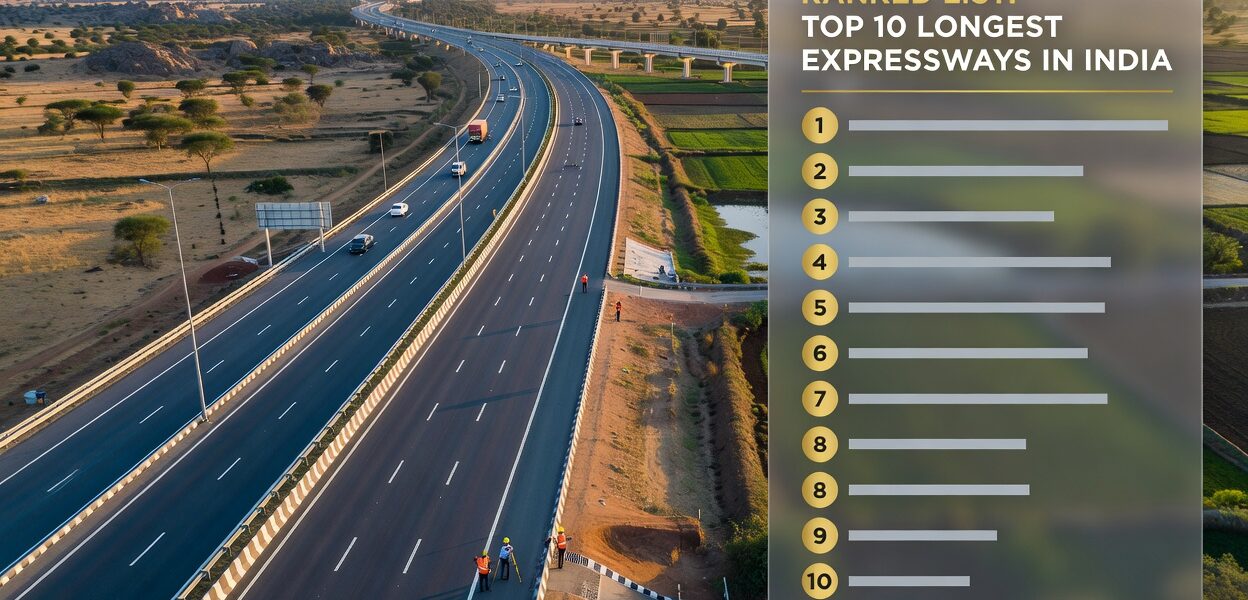
Top 10 Longest Expressways in India You Should Know
The expressway network in India is rapidly evolving, facilitating smoother travel and boosting logistics across the country. Understanding the longest expressways in India is crucial for travelers, businesses, and investors looking to optimize their routes and operations. These expressways not only connect major cities but also play a significant role in economic development and regional connectivity.
For more insights on infrastructure, check out our article on Top 5 Industrial Zones Along Ganga Expressway With Highest ROI in 2025.
1. Delhi–Mumbai Expressway
Stretching 1350 km with 8 lanes, the Delhi–Mumbai Expressway is currently 72% complete and is targeted for completion by 1 October 2025. This expressway will significantly reduce travel time between the national capital and Mumbai, enhancing trade and tourism between these two major economic hubs.
2. Nagpur–Bengaluru Expressway
The Nagpur–Bengaluru Expressway will cover a distance of 1300 km and feature 8 lanes. Although it is still in the proposal stage with a target completion date of 2025, its development is expected to strengthen logistics and connectivity between central and southern India.
3. Amritsar–Jamnagar Expressway
This expressway spans 1256.95 km and consists of 6 lanes, with 52% of the project already completed. Targeted for completion by 1 December 2025, it will enhance connectivity between Punjab and Gujarat, thus promoting economic activities in these regions.
4. Narmada Expressway
With a length of 1100 km and 8 lanes, the Narmada Expressway is proposed for completion in 2020. Although it is still in the planning phase, its significance lies in connecting multiple states along the Narmada River, enhancing trade routes in western India.
5. Nashik–Chennai Expressway
This upcoming expressway will stretch 900 km with 6 lanes and is expected to be completed by 2029. Its development will facilitate direct travel between Nashik and Chennai, improving trade and tourism in the southern and western regions of India.
6. Kharagpur–Visakhapatnam Expressway
Spanning 783 km and featuring 6 lanes, the Kharagpur–Visakhapatnam Expressway is proposed for completion in 2025. This expressway will enhance connectivity between West Bengal and Andhra Pradesh, boosting trade and economic activities in the eastern part of the country.
7. Hyderabad–Indore Expressway
Covering a distance of 713 km with 4 lanes, this expressway is targeted for completion in 2026. It will connect major cities in the southern and central regions, facilitating better logistics and travel options for businesses and commuters.
8. Varanasi–Kolkata Expressway
Measuring 710 km and consisting of 6 lanes, the Varanasi–Kolkata Expressway is expected to be completed by 2029. This expressway will improve connectivity between Uttar Pradesh and West Bengal, promoting economic growth and tourism in these states.
9. Raipur–Dhanbad Expressway
The Raipur–Dhanbad Expressway will extend 707 km with 4 lanes, targeted for completion in 2026. This route will enhance connectivity between Chhattisgarh and Jharkhand, supporting local economies and facilitating smoother transportation of goods.
10. Mumbai–Nagpur Expressway
At 701 km, the Mumbai–Nagpur Expressway is the only expressway on this list that is 100% complete. Managed by MSRDC, it was completed on 5 June 2025 and is pivotal in connecting Maharashtra’s capital with its rural regions, enhancing trade and travel.
In conclusion, these longest expressways in India are set to redefine travel and logistics, connecting key economic zones and enhancing overall infrastructure. For more detailed corridor data and updates, visit Expressway91.
Frequently Asked Questions
What is the longest expressway in India?
The longest expressway in India is the Delhi–Mumbai Expressway, which spans 1350 km.
How many expressways are currently under construction in India?
Several expressways are currently under construction, including the Nagpur–Bengaluru and Amritsar–Jamnagar expressways, among others.
What are the benefits of these expressways?
The benefits include reduced travel time, improved logistics, and enhanced economic connectivity between major cities and regions.
For more information, visit the National Highways Authority of India.
Infrastructure analysts tracking India's expressway network, industrial corridors, and investment zones since 2020. Data sourced from NHAI, MoRTH, UPEIDA and official project reports.
Leave a Reply