
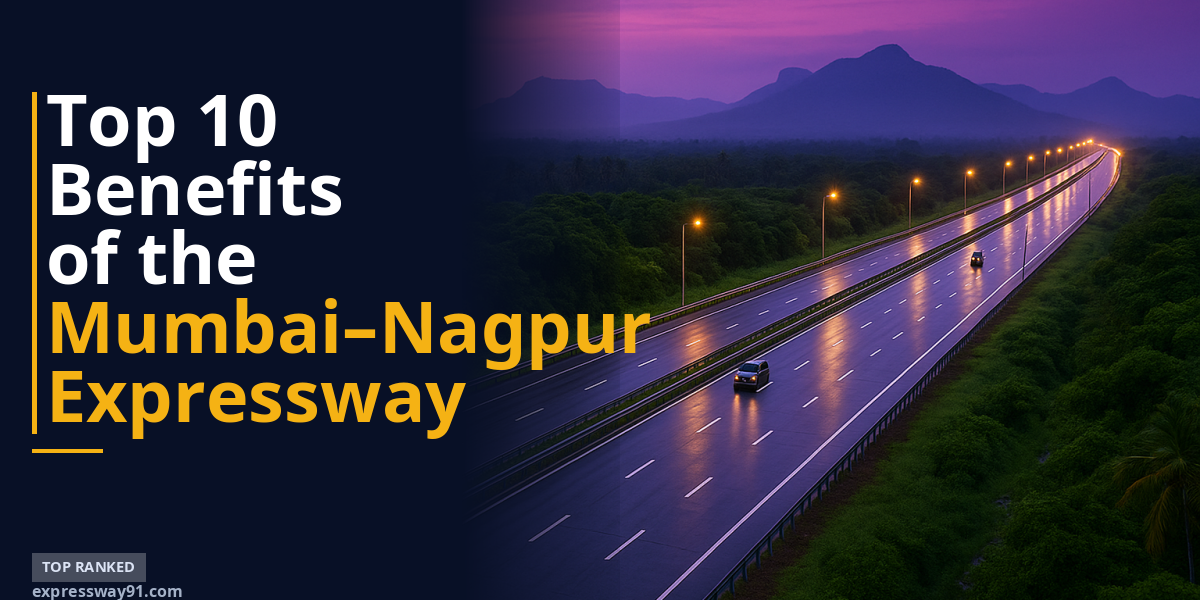
Top 10 Benefits of the Mumbai–Nagpur Expressway
The Mumbai–Nagpur Expressway is poised to transform travel and logistics across Maharashtra and beyond. With its strategic design and completion timeline, this expressway is set to enhance connectivity, reduce travel time, and boost economic growth. Understanding the benefits of this infrastructure can be crucial for travelers, logistics companies, and investors looking to capitalize on the improved routes.
For more insights into major expressway projects, check out Amritsar–Jamnagar.
1. Mumbai–Nagpur Expressway
The Mumbai–Nagpur Expressway spans 701 km and features 6 lanes, with 100% completion achieved as of June 5, 2025. Implemented by the Maharashtra State Road Development Corporation (MSRDC), this expressway connects major urban centers, significantly enhancing trade routes and reducing travel time. Its completion is expected to have a profound impact on economic activities, facilitating smoother logistics and better connectivity between Maharashtra’s key cities.
2. Delhi–Mumbai Expressway
Covering 1350 km with 8 lanes, the Delhi–Mumbai Expressway is currently 72% complete, with a target completion date of October 1, 2025. This expressway will connect the national capital to India’s financial hub, reducing travel time significantly and enhancing trade between these two economic powerhouses.
3. Nagpur–Bengaluru Expressway
Proposed to stretch 1300 km with 8 lanes, the Nagpur–Bengaluru Expressway is currently in the planning phase with a target completion set for 2025. This expressway aims to connect two major metropolitan areas, improving trade and travel between Maharashtra and Karnataka.
4. Amritsar–Jamnagar Expressway
At 1256.95 km and 6 lanes wide, the Amritsar–Jamnagar Expressway is 52% complete, with a target for completion by December 1, 2025. This corridor will enhance connectivity across northern and western India, enabling better logistics and economic development in these regions.
5. Narmada Expressway
The Narmada Expressway, spanning 1100 km and designed with 8 lanes, is proposed with a target completion date of 2020. This expressway aims to improve connectivity across central India, fostering economic growth and facilitating faster transportation.
6. Nashik–Chennai Expressway
Measuring 900 km with 6 lanes, the Nashik–Chennai Expressway is currently in the planning stages with a completion target set for 2029. This expressway will enhance trade routes between Maharashtra and Tamil Nadu, significantly impacting regional economies.
7. Kharagpur–Visakhapatnam Expressway
The Kharagpur–Visakhapatnam Expressway will stretch 783 km with 6 lanes and is proposed with a target completion date of 2025. This corridor aims to strengthen connectivity between West Bengal and Andhra Pradesh, boosting economic activities in the eastern region.
8. Hyderabad–Indore Expressway
At 713 km and featuring 4 lanes, the Hyderabad–Indore Expressway is set to complete by 2026. This expressway will enhance connectivity between Telangana and Madhya Pradesh, facilitating smoother logistics and travel.
9. Varanasi–Kolkata Expressway
Covering 710 km with 6 lanes, the Varanasi–Kolkata Expressway is planned with a target completion of 2029. This expressway will significantly improve connectivity between Uttar Pradesh and West Bengal, promoting economic growth in these states.
10. Raipur–Dhanbad Expressway
The Raipur–Dhanbad Expressway is set to span 707 km with 4 lanes and is expected to be completed by 2026. This route aims to enhance connectivity between Chhattisgarh and Jharkhand, facilitating better transportation of goods and services.
In conclusion, the Mumbai–Nagpur Expressway benefits not only travelers but also the logistics sector and regional economies. As this expressway becomes fully operational, it will serve as a vital artery for trade and travel in Maharashtra and surrounding states. For more detailed information on expressways, visit Expressway91.
Frequently Asked Questions
What is the length of the Mumbai–Nagpur Expressway?
The Mumbai–Nagpur Expressway is 701 km long.
Who is responsible for the implementation of the Mumbai–Nagpur Expressway?
The expressway is being implemented by the Maharashtra State Road Development Corporation (MSRDC).
When is the Mumbai–Nagpur Expressway expected to be completed?
The expected completion date for the Mumbai–Nagpur Expressway is June 5, 2025.
Infrastructure analysts tracking India's expressway network, industrial corridors, and investment zones since 2020. Data sourced from NHAI, MoRTH, UPEIDA and official project reports.
Leave a Reply